
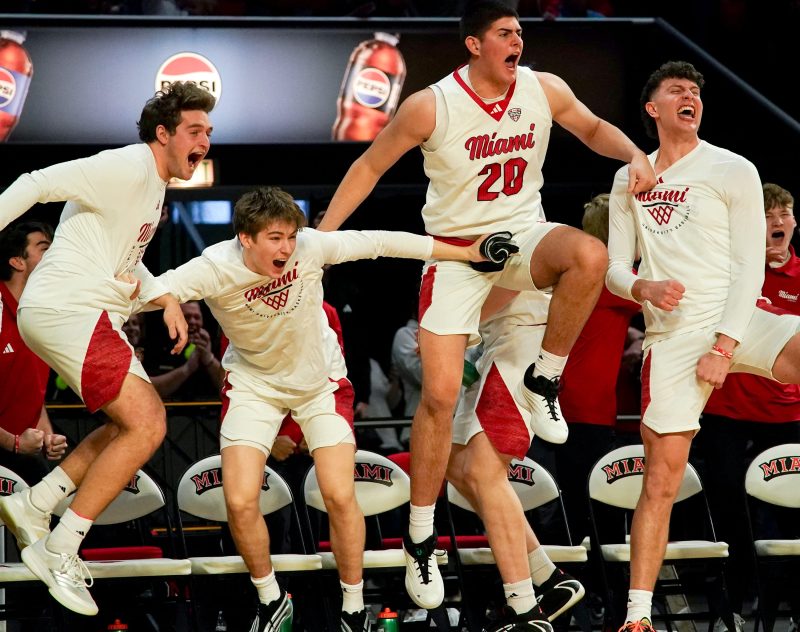
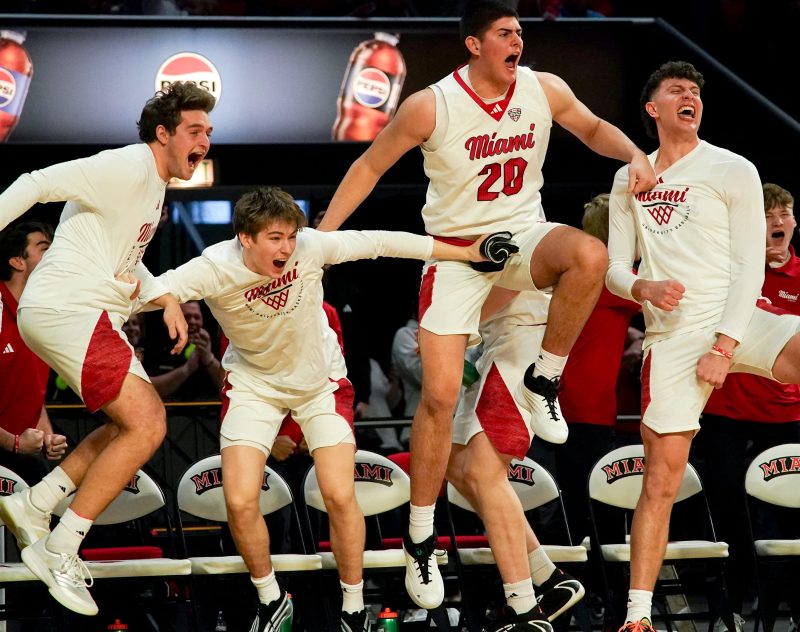
Above Travis Steele’s desk in his office on the Miami University campus in Oxford, Ohio is a three-by-five index card tacked to the wall, right above a picture of his five-year-old whoodle Ryder.
On it is a message written in red ink:
Be obsessed with your trajectory, not your current results.
It’s a mantra Steele is trying to embody in the middle of his fourth season as the RedHawks’ men’s basketball coach. Wins and losses matter, of course, but success is ultimately judged by whether his players and program are getting better on a given day.
This season, though, the results have been too good to overlook — and the rest of the country’s starting to take notice.
As February approaches and the start of the NCAA tournament inches that much closer, there are two remaining undefeated teams in men’s college basketball. There’s No. 1 Arizona, a squad led by a pair of five-star freshmen who are representing one of the most decorated programs in the sport over the past 40 years. The other? Steele’s Miami team, which is 21-0, off to the best start in the history of the Mid-American Conference and ranked in the top 25 for the first time in 27 years.
Along the way, the RedHawks have become one of the biggest stories in the sport, with a long-stagnant program enjoying the kind of attention and acclaim it hasn’t received since a Wally Szczerbiak-led run to the Sweet 16 in 1999.
“It’s really flipped,” Steele said to USA TODAY Sports. “It just shows that anything can be done anywhere in the country. It just takes a lot of people pulling in the same direction and it takes a vision. If you have all the alignment right, man, anything can happen.”
The run hasn’t exactly come from out of nowhere — Miami won a program-record 25 games last season, after all — but it has thrust Steele, his players and the school into a position few could have realistically envisioned even three months ago.
“It’s exciting for me to be doing what I’ve been doing with CBS since 2010 and now have my alma mater so relevant in the national landscape of college basketball,” Szczerbiak said to USA TODAY Sports. “It’s awesome. It’s a dream for me.”
Miami Ohio basketball’s long road back to relevance
Miami’s path to perfection has been hard-earned.
For decades, it was one of the more successful mid-major programs in the sport, crashing the regional semifinals of the NCAA Tournament four times from 1958-99 and serving as a launching pad for future NBA standouts like Szczerbiak and Ron Harper.
Since the turn of the century, though, the RedHawks’ fortunes waned. They’ve made the NCAA Tournament just once since their Sweet 16 appearance in 1999. In many of those years, they haven’t gotten particularly close, either. Over a 15-year stretch, from 2009-24, they finished with a winning record just once — and that was a 12-11 mark during the COVID-19-affected 2020-21 season.
When the university hired Steele after the 2022 season, it was in search of a long-awaited jolt.
“They wanted it, but the fan attendance wasn’t there, the support wasn’t there,” Steele said. “I knew it was going to be a rebuild in a lot of ways when I took it over. I knew we’d have to get more talent and get the culture right. But I probably didn’t realize quite how much the rebuild was going to be because of the disconnect with former players and the current program and the community and the current program. It just wasn’t there.”
At the time, Miami’s new coach was in search of a restart just as much as the program he was inheriting.
In 2018, at 36 years old, Steele was named the head coach at Xavier, where he’d helped lead the Musketeers to a Big East championship and a No. 1 seed in the NCAA Tournament as their top assistant the previous season. His teams never bottomed out, but they had a clearly defined ceiling, never winning more than 19 games and missing out on the NCAA Tournament four years in a row at a program that had made it to March Madness in 26 of 33 seasons before he took over. After going 19-13 in his fourth season at the school with a team that missed the tournament despite a 16-5 start, Steele was fired.
In the days that followed, he mulled his future. He wasn’t burnt out and didn’t feel the need to step away from coaching. While he felt like he didn’t have a purpose being away from a team and a locker room, he also didn’t want to rush back to the sideline for the sake of it. The fit had to be right.
In Miami, he found just that — a school with a strong academic reputation and an idyllic campus that allowed him to stay in southwest Ohio, where his wife, Amanda, was from and where he had lived since 2008. Just 15 days after he was let go at Xavier, he’d accepted a new challenge.
“You live and you learn, right?” Steele said. “I made a lot of mistakes at Xavier. I made some mistakes and you don’t want to make those again. You figure out fit is everything. What are your non-negotiables?”
Miami Ohio’s basketball renaissance
In his early discussions with Miami athletic director David Sayler, Steele warned that his approach may take some time to materialize.
He wasn’t wrong. The RedHawks struggled in their first two seasons under their new coach, going 12-20 in the 2022-23 season and before a modest improvement to 15-17 in 2023-24.
By Steele’s third season, and with players he brought aboard earlier in his tenure stepping into larger roles, Miami got a long-awaited breakthrough. It went 25-9, its first 20-win season since the 1999 Sweet 16 team, and fell one game short of the NCAA Tournament, losing to Akron 76-74 in the MAC championship game on a layup with two seconds remaining.
Now, a team picked to finish second in the MAC has shattered even the more optimistic expectations that greeted it entering the season. While it’s not rare for a power-conference program to flirt with an undefeated season heading into February, Miami’s only the seventh non-Gonzaga team from a mid-major league to start a season 20-0 since 1990.
“You really just enjoy the moment when you have it because you may never have this again,” freshman guard Justin Kirby said to USA TODAY Sports.
The RedHawks haven’t just gotten to 21-0, but they’ve done so with an unmistakable flair.
Steele overhauled his style after arriving at Miami, leaving behind his more plodding approach at Xavier for an offense that’s now 46th of 365 Division I teams in tempo, according to KenPom. They’re not just fast, but efficient, ranking fourth nationally in 2-point percentage, 18th in 3-point percentage and 23rd in free-throw percentage while rarely turning the ball over. Six players are averaging at least 10 points per game and six of the team’s top eight scorers are shooting at least 40% from 3 — and the two who aren’t are both at 39.4%. They’ve managed to do that despite playing about half the season without starting point guard and team captain Evan Ipsaro, who tore his ACL in a Dec. 20 win against Ball State.
It’s a free-flowing style, another contrast from Steele’s Xavier tenure. He said he sometimes calls as few as five set plays over the course of a game, preferring for his veteran roster to play in the flow of a contest with the concepts he has taught them.
The 21-0 mark hasn’t come without some fits of anxiety. Miami’s past three wins have come by a combined 11 points, with two of those victories — against Buffalo and at Kent State — coming in overtime. In the Buffalo game, Eian Elmer hit a buzzer-beating 3 to send the game to overtime before Peter Suder broke a tie with a 3 of his own with one second remaining in the extra period. On Tuesday, the RedHawks overcame a 10-point first-half deficit to knock off UMass.
Miami’s unblemished start has been made possible, in part, by a soft non-conference schedule that KenPom ranks as the fourth-easiest in the country. Three of its wins came against non-Division I teams and of the nine Division I squads they faced in non-conference play, only one (Wright State) currently has a winning record.
The RedHawks’ success isn’t a mirage, though. Their strength of record is 20th among all Division I teams, putting them above the likes of No. 18 North Carolina, No. 19 Clemson, No. 20 Louisville, No. 23 St. John’s and No. 25 Iowa.
As their wins mount, interest in the program has, too, with a fan base hungry for national relevance embracing the team that has given it to them. After averaging 2,656 fans per game last season, Miami moved to 8-0 in a Dec. 6 win against Maine in front of a home crowd of 1,349 on hand for the final home contest before the fall semester ended. With students back on campus, Tuesday’s 86-84 victory against UMass attracted 9,223 fans. It was the 10th-largest crowd in the history of 57-year-old Millett Hall, the RedHawks’ home arena, and the largest since 1996.
“The program has just totally taken off,” Szczerbiak said. “Ticket sales are through the roof. The excitement is there. It’s exactly what the program deserves and needs.”
Beyond attendance figures, the storybook start has reconnected generations of Miami fans to the program.
A quarter-century since he last suited up for the RedHawks, Szczerbiak has a daughter who’s a sophomore at Miami who attends all the games. Sophomore guard Luke Skaljac, who stepped in for Ipsaro after his injury, is the son of two Miami graduates and grew up in suburban Cleveland hearing stories from his father about Harper and Szczerbiak’s heroics.
Now, those halcyon days are back.
“It’s definitely surreal for him,” Skaljac said to USA TODAY Sports. “He’s kind of amazed this is happening right now and that I’m a part of it.”
How Miami Ohio built a winning roster — and kept it together
The RedHawks have been an unlikely success story, not only because of their record, but the way they’ve reached it.
During an age when immediate eligibility for transfers can radically reshape rosters at a given school annually, Miami has been a model of continuity. Twelve of the 15 players who have logged at least one minute this season for the RedHawks began their college careers at the school.
Like virtually anyone else in the sport, Steele has used the transfer portal. Three of Miami’s top six scorers this season — Suder (from Bellarmine), Almar Atlason (Bradley) and Antwone Woolfolk (Rutgers) — transferred in from other Division I programs. It’s been more of a complementary tool, one used to fill in holes rather than build an entire team. For Steele, retention is his No. 1 priority.
At a mid-major like Miami, that’s far easier said than done. Every spring, eager power-conference programs pluck the top scorers and best players of teams from smaller leagues with shallower pockets.
For the most part, the RedHawks have managed to avoid that fate in a sport increasingly designed to make stories like theirs impossible. Though they lost players to Kentucky and Georgia Tech over the offseason, they brought back five of their top six scorers from last season’s 25-win squad, all of whom had remaining eligibility. It’s not just players, either. Four of Steele’s five assistant coaches have been by his side since he took over at Miami.
How’d they do it? Steele and his players credit a close-knit, familial atmosphere that has been fostered over the years, which has been enough to hold on to many standouts at a program that’s reportedly in the middle of the MAC when it comes to name, image and likeness resources.
“You just aren’t going to find a better fit than Miami, especially for a lot of us,” Skaljac said.
Steele said he doesn’t give a breathless recruiting pitch to his players after every season, instead stressing the value of long-term decisions over short-term ones and how staying at Miami and earning a degree from the school benefits them.
“The grass isn’t always greener. It’s not,” Steele said. “I think those guys know that. They’ve heard stories from friends that are at other places. What we have is special. That doesn’t mean we’re going to be perfect keeping everybody. I’m OK with that. I want guys that want to be here.”
That carryover has allowed the RedHawks to dream at this late stage of the season.
As of right now, Miami figures to be a favorite in each of its 10 remaining regular-season games and it has already beaten the two teams directly behind it in the MAC standings, Akron and Kent State. Some sizable obstacles remain, though, with KenPom giving the RedHawks a 5.1% chance of finishing the regular season unbeaten.
But an undefeated season, while nice, was never the goal for this group. After the gutting loss in last year’s MAC title game, the biggest priority has been getting back to the NCAA Tournament for the first time in nearly 20 years. Even with Miami’s hot start, that’s hardly a guaranteed destination, especially coming out of what’s almost always a one-bid league. One ill-timed slip-up or an off shooting night could undo weeks and months of perfection.
That leaves the RedHawks with a straightforward objective – just keep winning. So far, they’ve been pretty good at it.
“The results will take care of themselves if our process is right,” Steele said. “It may not always happen immediately, but eventually it will figure itself out. That’s why our guys have been so loose. We feel no pressure, none. Our guys are enjoying it. We’re having fun on this journey together.”
Miami Ohio basketball 2026 schedule
Here’s who the RedHawks have left on their schedule:
- Jan. 31: vs. Northern Illinois, 3:30 p.m. (ESPN+)
- Feb. 3: at Buffalo, 6:30 p.m. (ESPN+)
- Feb. 7: at Marshall, 4 p.m.
- Feb. 13: vs. Ohio, 8 p.m. (ESPNU)
- Feb. 17: at UMass, 7 p.m. (ESPN+)
- Feb. 21: vs. Bowling Green, 3:30 p.m. (ESPN+)
- Feb. 24: at Eastern Michigan, 6:30 p.m. (ESPN+)
- Feb. 28: at Western Michigan, 2:30 p.m. (ESPN+)
- March 3: vs. Toledo, 7 p.m. (ESPN+)
- March 6: at Ohio, 7 p.m. (ESPN+)
- March 12-14: MAC Tournament, at Cleveland