
I am brave.
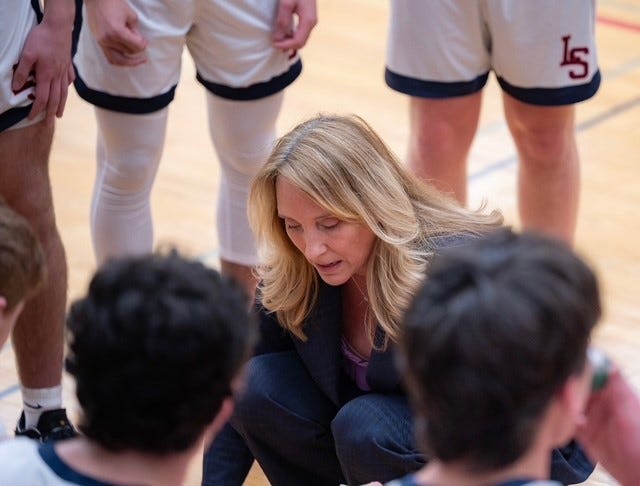
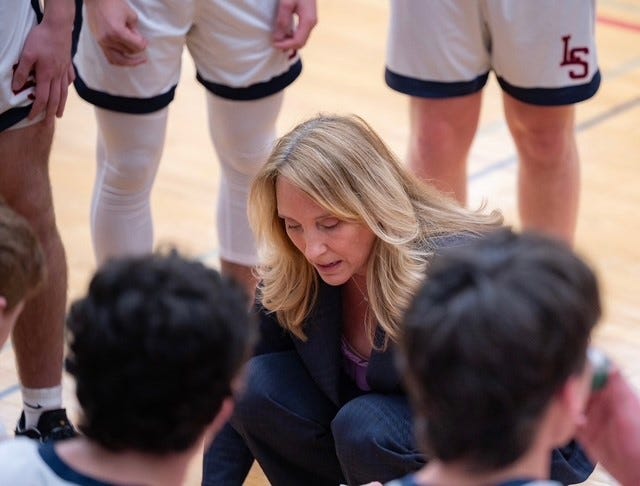
Linda Martindale wasn’t brave, at least she didn’t think she was after she had been hired as a varsity boys basketball coach.
“Once the game started, I was fine,” says Martindale, now in her sixth season leading Lincoln-Sudbury (MA), “but walking into the gym and people thinking I’m the scorekeeper or whatever, I had to sort of overcome this feeling of, ‘Do I belong in the gym?’ ”
She made the three words her mantra, and she convinced herself she was brave. You need to be as an athlete, or a coach, in today’s world of youth sports.
“I have fond memories of my athletic career, but I also know there was a lot of heartache and it was very difficult,” says Martindale, who played Division II basketball at Alaska-Anchorage and in the old Pac-10 at Arizona in the late 1980s and early 1990s. “But nowadays, it’s totally different. Your whole career is splashed all over social media.”
Martindale’s father devoted his life to coaching baseball and football, driving her and her three siblings to be punctual and polite. He was hard on them, she says, but led with love.
“If I had a bad game, the people in the stands knew and my parents knew, and that was it,” Martindale tells USA TODAY Sports. “You’d come home and your parents would say, ‘How did the game go?’ You could self-report that. Easy to deal with.
“My oldest son would literally get DMs from strangers that say horrible things if he missed a free throw in the clutch. The landscape is very different. And it obviously trickles down to youth.”
Martindale got certified as a mental fitness coach to help ease the pressure on her three sons and one daughter (all of them have played college sports) but also other young athletes.
She works with sports teams at Division I Holy Cross and D-III Curry College, as well as individual athletes. She says there’s a secret beyond the physical component to playing sports in college.
We offer 10 ways, through consultation with Martindale, for parents to help athletes get there.
1. Develop the coach in your head: It’s the best one you’ll ever have
When Martindale walked into the gym feeling the male eyes on her, she felt she needed an inner coach.
Your coach on the court or field will tell you what to do but, Martindale says, the one in your head will kick you in the butt to help get you where you need to go.
Jenny Levy, who has won four national titles as North Carolina’s women’s lacrosse coach, believes so strongly in an inner coach she likes when her players form their own mantras.
“Confidence looks good on you,” she heard her players say to each other in 2013, the year they broke through.
“A lot of coaches will say, ‘This is our saying,’ ” Levy told Martindale on Martindale’s ‘Game Changers’ podcast. “And I think that’s fine – to each his own – but I actually let our team organically come up with their own little things. This is the team having a good time together.”
The inner voice tells you it doesn’t matter what anyone else thinks, only what you do.
Go for it.
This is my time.
This is where I belong.
To come up with your own mantra, Martindale says, ask yourself why you play a sport? Look for performance cues to grind that thought into you.
“It’s not fun to lose, but it’s still really fun to compete and to play,” Martindale says. “OK, good, let’s start with that. So at least you can say it’s not fun to lose, but it’s really fun to prepare for the game. We’ve now established that the majority of the time is fun. Now we can get through the parts that aren’t fun.”
Was that ‘fun’? How Coco Gauff’s tough US Open embodies what the word means
2. We can learn how to handle the hard
Kids respond to the truth. We don’t need to always sugarcoat it.
Instead of saying, “It’s not so hard,” acknowledge that something is.
Maybe you’re afraid that you might lose or you’re going to make a fool of yourself in front of everybody.
“I’m happy that you can articulate a fear,” Martindale might tell an athlete. “Now, let’s squash it. What are you really afraid of? Is it really embarrassing to lose, or is it embarrassing not to play at all?
“It would be embarrassing if you threw yourself on the floor and screamed and cried in the middle of the game. But nobody thinks it’s embarrassing that you sat on the bench, cheered on your team, and then fought another day to try to get some minutes.”
3. Teach your kid how to build resilience to meet challenges head on
A current role doesn’t mean an ultimate role. Martindale goes back to Tom Brady.
He was once buried deep on Michigan’s depth chart. But he focused on nailing reps he got in practice. He was at game speed when he found himself starting.
“As parents, we say, ‘I don’t think you should have to be the backup quarterback,’ ‘ Martindale says. “ ‘I think you should be the quarterback.’ This is not helping. What you need to do is crush being the backup. And then your time comes and you’re ready instead of spending so much time worrying that you don’t have the role that you want (and) you’re not ready for it.”
Another of her podcast guests, Luke Avdalovic, a former walk-on basketball player at Northern Arizona University, told her: “I had a teammate named JoJo Anderson and he told me, ‘If you want to find a role into this team, find one thing that you’re really good at. Make sure you’re head and shoulders better than every single other person on the team. Then they can’t take you off the floor.’ ”
Avdalovic became a top sharpshooter who rose to the NBA G-League.
4. ‘You can’t be a shooter if you can’t miss’
Avdalovic has shot so much over the years he feels he’s never really in a slump. Some days he shoots better than others, but that is just the law of averages.
“You can’t be a pitcher if you can’t pitch poorly,” Martindale says. “You can’t be a shooter if you can’t miss. It’s just not possible (to) be perfect. So what do you do when you’re imperfect?”
The next time your son or daughter has a bad game, ask them, “Did you compete hard?”
You don’t want them to lose or fail but they need to know how to do both. As parents, and as coaches, our best support can come out of struggles.
5. We can only get the ‘yips’ if we vocalize them
You know the term if you’re a baseball fan. Suddenly, Steve Sax or Chuck Knoblauch can’t make a routine throw from second to first base, or Rick Ankiel can’t throw a strike.
“Yips is not a real thing,” Martindale says.
Struggles come alive, she says, when we say them out loud. Instead, if you’re a parent or a coach, tell your athlete: “I really believe in you. Just keep throwing, you’ll get it back, you’ll find a rhythm.”
When kids feel deep-rooted support, they have more confidence in themselves.
6. We don’t have to be good at everything
Martindale says today’s world for young athletes is like taking the SATs while your score is being put on a scoreboard.
Sometimes, it seems, we expect our kids to be good at everything. Martindale asks the ones with whom she works, “What class are you good at?”
She doesn’t necessarily mean classes in which they have an “A,” but the ones they enjoy most.
Sometimes it takes looking at things through a less critical lens. We have an “A” in science, but we enjoy the challenge of English Lit, in which we have a B-, which energizes us to try and bring up the grade.
7. ‘It’s not your family’: Parents are the ultimate artery of support
Eugene Glisky, Martindale’s father, had his ashes buried on the field where he coached near Toronto. She suspects he changed the lives of many young men.
But she stops short of calling a team a family.
“When a coach says to a parent, ‘I’m gonna treat your son or daughter like my own,’ I want to say, ‘No, thank you. I don’t need you to treat my son like he’s your own,’ ” Martindale says. “He has a great father. What I really want you to do is treat him like a player and a human being.
“It’s a team, which is amazing and I love my kid being part of a team. But it’s not a family. Why? Because what happens when your family cuts you?”
There are times when we need to be Coach, and times when we need to be Mom or Dad. Martindale had to be Coach when Judson, her oldest who now plays basketball for Manchester Basketball Club in the United Kingdom, came out of a game when he was younger and looked at her like, “Why are you pulling me?
He threw his water bottle, and she turned and said: ‘You can take your sneakers off. You’re done.’
The same coach, though, drove him home from a different game, criticizing him for what he didn’t do while failing to realize he was sick.
‘So many examples of total failure by me,’ she says. ‘What kind of mother would be talking to their kid about some offensive set when clearly they needed a mother?’
8. ‘Your influence is not neutral, parents’; don’t disrupt a happy kid
Levy, North Carolina’s women’s lacrosse coach, does parent Zoom calls. Before the first one, she asked her players what they wanted her to tell them.
“They said, ‘We don’t want to talk about the game at the tailgate after,’ ” Levy told Martindale. “ ‘We don’t want any parent to have this sad conversation after the wins because their kid didn’t play. We want the parents to sit together. We want them to be positive on the sideline.’ ”
Levy says the players gave her a Letterman top 10 of parent no-no’s, which she shared on the Zoom.
“I think they were pretty shocked,” says Levy, who coaches her daughter, Kate, on the team. “Our kids were like, ‘Last year was not OK. This is what we want and this is what we need this year.’
“And then if we saw it, I had permission from our players to call the parent and say, ‘Hey, you’re at the tailgate and your behavior was below the line for our program.’
“What if I acted like that as a parent? What if I did that in the middle of a tailgate?”
Levy’s point: A kid could be completely happy but if the parent is unhappy with their role, then the kid’s unhappy. And if the parent isn’t feeling like their kid is getting a fair shake, or they’re being really negative toward coaches or teammates, the kid internalizes the feeling.
“Your influence is not neutral, parents,” Levy says.
9. We can use even a little bit of winning to fuel us
During a clip Martindale shared of her speaking to athletes, she says, “There has to be wins in there. Otherwise, you can’t go an entire season and be like, ‘If we don’t win a game, this whole season is a waste.’ ”
She is not necessarily talking about checks in the “W” column as much as what we perceive as personal wins. Maybe you tell a teammate you loved the way he blocked a punt or moved into position on defense. If we don’t have wins, even within losses, you don’t learn how to win.
10. So what’s the secret sauce?
Martindale believes there are five pillars of mental fitness: 1. Staying in the moment; 2. Controlling the controllables; 3. Seeing mistakes as opportunities; 4. Not judging yourself (or others) too harshly and 5. Comparison (positively).
She says she was once a failure at all of them. Has she since learned a special ingredient we need to have to play college sports?
Martindale thinks Angela Duckworth, director of the Penn-Wharton Behavior Change for Good Initiative, said it best.
“It’s grit,” Martindale has said. “I’m obsessed with grit, because we know it’s a single defining characteristic of successful people.
“Can you get up after you get knocked down? The athletes who are successful at every level of college, I think, have this kind of dog mentality that is about grit. And of course, you have to be skilled and you have to be athletic but when we really look at who performs best when it counts, it’s people who have failed. Over and over and over. And then now they succeed.”
We can’t beat our kids up over mistakes. Let them hear the voice in their head that gives them the grace to move forward from them.
Then, as Martindale says: “Watch them fail and then watch what they do after they fail.”
Borelli, aka Coach Steve, has been an editor and writer with USA TODAY since 1999. He spent 10 years coaching his two sons’ baseball and basketball teams. He and his wife, Colleen, are now sports parents for two high schoolers. His Coach Steve column is posted weekly. For his past columns, click here.