
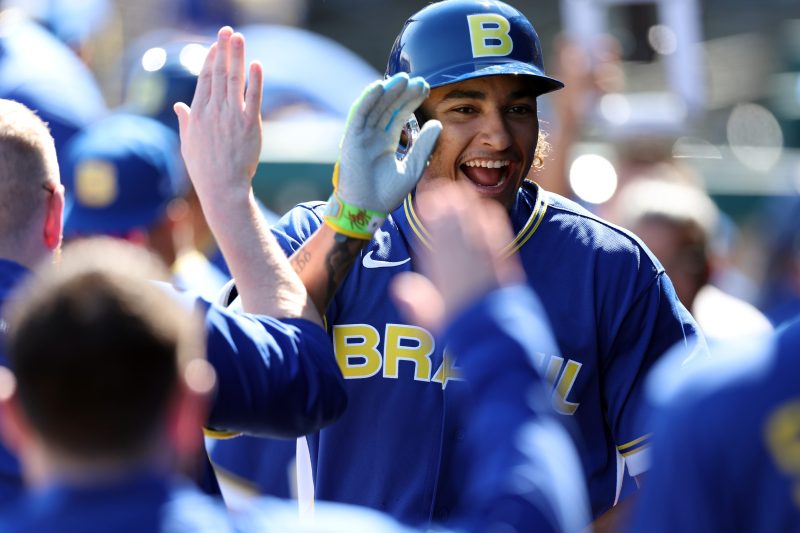
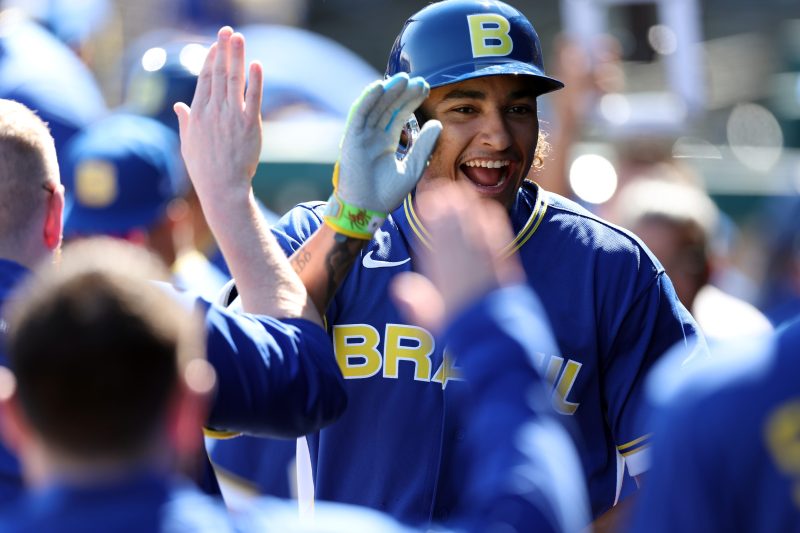
HOUSTON — If it wasn’t already clear from Dante Bichette Jr.’s jersey which contingent he was a part of at the World Baseball Classic, his head offered a less-than-subtle clue.
Two weeks ago, Bichette Jr. enlisted the help of a hairstylist friend in Los Angeles to dye his shoulder-length hair bright green, matching one of the main colors in the Brazilian flag.
During Team Brazil’s pre-WBC workout Thursday at Daikin Park, Bichette Jr. added a bandana of the Brazilian flag on top of his colorful mane prior to donning a blue-and-yellow cap.
“Last year I had green that turned into yellow, this year I put dark green so it would stay a little bit,” Bichette Jr. explained.
After going 3-1 in last year’s qualifiers, Team Brazil is back in the World Baseball Classic for the second time ever and first time since 2013. Brazil opens the tournament with a game against host country USA on Friday night in Houston.
The Brazilians are acutely aware of their underdog label. They wouldn’t have it any other way.
“Any good movie I’ve ever seen starts with an underdog story, you know?” Bichette Jr. said. “Now, this is a challenge, for sure. But nine innings and it’s a baseball game, and a lot of the time this type of games comes down to heart. When it comes to heart, we can hang.”
Brazilian pitcher Rodrigo “Bo” Takahashi added, “The pressure, it’s on them.”
After a painstaking yearslong fight to get back into the WBC, though, Brazil is aware that the WBC presents a significant opportunity to showcase its baseball talent on a global stage and pave the way for the sport’s continued growth.
Leonardo Reginatto, 35, is a veteran infielder who played for Brazil in the 2013 WBC alongside many members of this year’s coaching staff, including manager Daniel Yuichi Matsumoto. Back then, Brazil was considered a sleeping baseball giant. It never fully awoke.
“It’s been tough, in a way, that we didn’t qualify twice. But I think that makes us better as a whole,” said Reginatto, Brazil’s team captain. “So now, it’s up to us to stay here and win a couple games.”
There have been just five Brazilian-born players to compete in the major leagues. The first, former MLB catcher Yan Gomes, is a catching coach on Brazil’s WBC staff.
While there aren’t any active MLB players on Brazil’s 2026 WBC roster, the team includes several notable connections to the majors. Bichette Jr. is the son of four-time All-Star Dante Bichette. Lucas Ramirez, the son of Manny Ramirez, plays for the Los Angeles Angels’ High-A team. High school prospect Joseph Contreras, whose father is José Contreras, is 17 and the youngest player on any WBC roster.
The American-born Ramirez, whose mother is Brazilian, could have chosen to play for the United States or for his father’s native country, the Dominican Republic. He chose Brazil for reasons both practical and sentimental. Ramirez figured he would get more playing time with Brazil, but he also has fond memories of Christmastime visits to Brazil, where his grandfather owns a livestock farm inhabited by cows and goats.
Ramirez said his aunt and uncle are flying from Brazil to Houston to watch him compete in the WBC, along with his parents. His grandparents will watch from Brazil on television.
“It’s awesome,” Ramirez said. “I would never expect that Brazil would fall in love with baseball, but I’m just grateful they did because it gave me the opportunity to come out here and showcase my abilities.”
Bichette and his brother, New York Mets infielder Bo Bichette, have both played for Brazil because their mother is a Brazilian native. Bo Bichette withdrew from the WBC this month to focus on transitioning to play third base for the Mets after signing there this offseason. But Dante Jr. said his family is ecstatic that he is representing Brazil – particularly his maternal grandparents, who both live there.
“My grandma, my vovó, is my best friend,” Dante Bichette Jr. said. “She’s the only person who we speak 100% transparently with each other. She is overwhelmed with joy that I’m even here. She loves to see the Brazil jersey on me.”
In 2025, MLB launched its development academy in the Brazilian state of São Paulo. But soccer remains the country’s pre-eminent sport.
On Thursday, Brazilian outfielder Osvaldo Carvalho delighted onlookers by using his feet to juggle a baseball on the grass down the third-base line.
Children in Brazil are usually only exposed to baseball if they know somebody who plays – and even then, it can be difficult to acquire the necessary equipment or find a field, explained Reginatto. He was introduced to the sport by Japanese neighbors in his hometown of Curitiba, Brazil, where today there are still only two baseball teams in the city with a population of one million people.
“There aren’t a lot of places to practice or things like that, but we always find a way,” Reginatto said. “The hardest part is that everybody was from a different area of the city and we all had to come from a different place to practice because there was only one field and only one cage.”
Japanese immigrants were responsible for helping popularize baseball in Brazil and developing infrastructure to help the game take root there. Many Brazilian baseball players play professionally in Japan; Matsumoto previously played for the Tokyo Yakult Swallows in Nippon Professional Baseball.
Reginatto said that while in recent years American influence has injected more power hitting into Brazil’s traditionally small-ball style, he described Brazilian baseball as a unique melting pot blended with Cuban and Venezuelan culture.
“We have players here who have never played professional baseball before and they’re facing big-league guys and having fun,” Reginatto said. “We know it’s hard but we have talent. We have a lot of Japanese people behind us, a lot of Cubans that came to Brazil, guys that came here to play in the major leagues, guys that play in the minors. Brazil is a big mix of baseball. Everything’s combined and we’re like a family. It means a lot to all of us.”
Describing the Brazilian game, Takahashi said, “It’s own style. It is something else, for sure.”
When Takahashi was a teenager, he woke up at 5 a.m. to watch the national team play in the 2013 WBC, which took place in Japan. Now Takahashi, a 29-year-old righthander, is preparing to pitch in the Classic himself.
“To have that memory, to watch them but now share the same field with them, that’s amazing for me,” Takahashi said.
Brazil is searching for its first WBC win after it went 0-3 in the 2013 tournament. But there is a sense of optimism stemming from Brazil’s second-place finish in the 2023 Pan American games and three wins in last year’s WBC qualifiers.
“This group is very special,” Bichette Jr. said. “The coaching staff all the way down to the players and then the additional people that have joined us on the way. Honestly, more than anything, this is a bit of a celebration.”
Brazilian players said they feel their country’s passion behind them and they hope their performance in the WBC can help sustain that excitement.
“Even people that didn’t know Brazil has baseball are commenting on social media and stuff like that, ‘Oh, we don’t understand the rules but we’re gonna be rooting for you guys!’” Reginatto said. “So that’s pretty cool. I hope that will expand baseball in the future at some point.”