
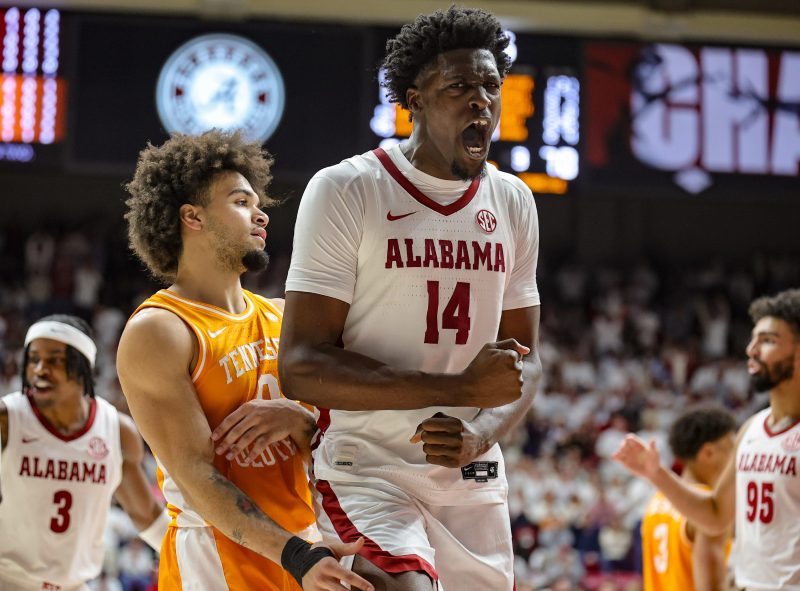
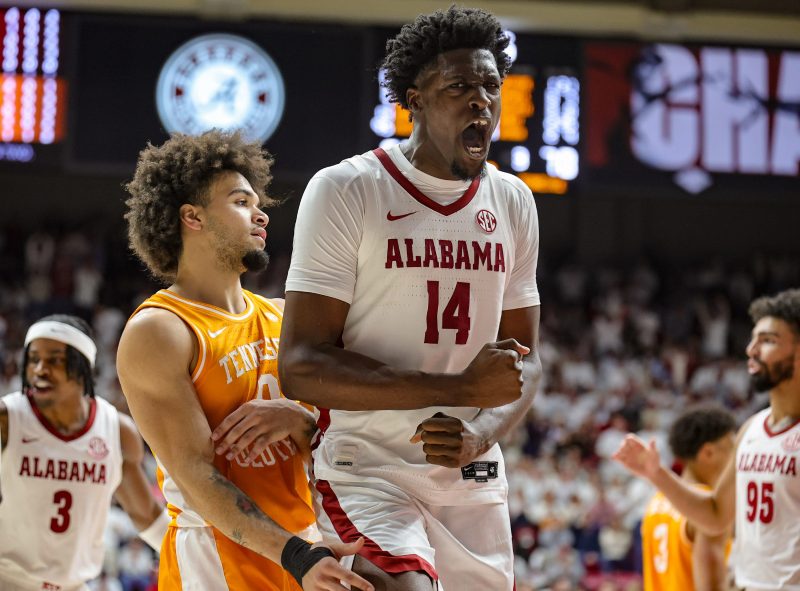
- Greg Sankey recently sided with the NCAA, at expense of Alabama, in a lawsuit over a player’s eligibility.
- Sankey previously supported Alabama when it benefited the SEC’s brand, prestige and earnings.
- An Alabama judge ultimately ruled against player Charles Bediako, upholding NCAA eligibility rules.
Down South, one big conspiracy theory has nothing to do with the moon or JFK.
Instead, the yearslong whopper that ran rampant within SEC terrain centered on conference commissioner Greg Sankey being an “Alabama homer.” A native New Yorker turned elephant backer. Secretly wrote all of his “A’s” in script handwriting.
Professional provocateur James Carville once alleged “collusion” between the SEC office and Alabama. Some might say the Ragin’ Cajun, an LSU alumnus, was the one suffering from bias, but I digress.
Here lately, Sankey sure is acting funny for a supposed “Alabama homer.” He must have forgotten his SEC office in Birmingham, aka East Tuscaloosa, operates as a Roll Tide cabal.
Or, maybe Sankey was just never the full-fledged Alabama homer some fans of rival teams made him out to be. Like most conspiracy theories, this one lacked sufficient proof.
Those old Alabama-SEC collusion claims shriveled last week. Sankey turned heel on Alabama and sided with the NCAA in a lawsuit to determine whether the Tide could continue playing former pro basketball player Charles Bediako in their march toward March.
Days after Sankey filed an affidavit supporting the NCAA, a judge in Alabama ruled against Bediako and in favor of the NCAA. This halted the NBA G League dropout’s days of dunking on college dudes.
Judge Daniel Pruet used legalese to explain his decision, language like Bediako “failed to establish that he would suffer irreparable harm” if he did not receive his desired ruling. He also cited NCAA bylaws.
NCAA “rules do not permit a student-athlete to participate in collegiate basketball, leave for the NBA, and return to the collegiate arena,” Pruet wrote. “All the evidence in the record indicates that the (NCAA) has consistently applied this specific rule.”
Left unwritten: The SEC commish casting his lot with the NCAA surely didn’t help Bediako.
Greg Sankey as ‘Alabama homer’ theory loses steam
So, what gives? Is Sankey an Alabama homer or a hater?
Neither.
He’s an SEC homer. That comes with the job. If Sankey and his office seemed like an Alabama homer before, maybe that’s because Nick Saban ruled college football. Saban’s high tides (and bountiful trophies) lifted the SEC’s boats.
If Sankey had to stump and maneuver a bit on behalf of Saban’s Alabama, well, that’s just good business.
Three years ago, Sankey summoned every ounce of propaganda he could muster while campaigning for the SEC’s champion, which wound up being Alabama, to get the final College Football Playoff spot, at the expense of undefeated Florida State.
Playoff rejection would have been costly to the SEC’s brand, ego, prestige and earnings. Anyway, what was good for Alabama also was good for the SEC, and it wasn’t particularly bad for college sports. It was just bad for Florida State and the ACC.
What Greg Sankey wrote in Charles Bediako affidavit
In this case, Bediako playing was fine for Alabama, but not especially beneficial to the SEC, on the whole. He didn’t even transform Alabama into a top national championship contender. He just made Alabama better than it was without him.
Bediako playing wasn’t ideal for Auburn when the former pro scored 12 points in Alabama’s 96-92 rivalry win, his final game before the judge’s ruling.
Other SEC teams aren’t playing guys who left college, declared for the NBA draft, played in the G League, and returned to college hoops years later, in violation of NCAA bylaws. As other teams follow the rules, Bediako and Alabama tried to sidestep them in court.
“Permitting former professional athletes to return to (college) competition creates a competitive disadvantage and fundamental unfairness for current student-athletes,” Sankey wrote in his affidavit in support of the NCAA.
Sankey has spent his career working within college sports. He worked in compliance on his way up the ladder. I suspect, at his core, he believes rules are good, a lack of rules is bad, rule-by-lawsuit is messy, and an ability to enforce eligibility rules is key to successful operation of any league.
Alabama coach Nate Oats and Bediako’s lawyer will point to the duplicity of the NCAA restricting Bediako from playing while permitting international players who previously played in foreign pro leagues or in the NBA G League, before later enrolling in college.
Hypocritical? Maybe.
Muddy? Absolutely.
Grounds for an injunction? Not according to an Alabama judge.
When Bediako left Alabama, declared for the draft and signed an NBA contract, NCAA rules said he wouldn’t be allowed to return to college ball. The rules still say that.
A healthy debate can be had about what it really means to be a pro athlete, when an NBA G Leaguer sues to get back in a college uniform, where he can earn more money. Amateurism is dead. Bediako wanted to leave one paycheck from the NBA G League for a better paycheck in college.
An Alabama homer would say, what’s the problem with that?
Sankey saw a problem. He’s no Alabama homer, after all.
Blake Toppmeyer is a columnist for the USA TODAY Network. Email him at BToppmeyer@gannett.com and follow him on X @btoppmeyer.