
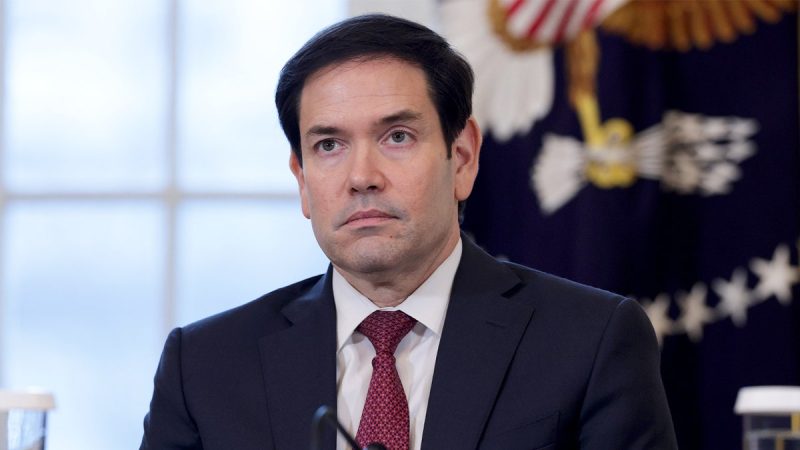
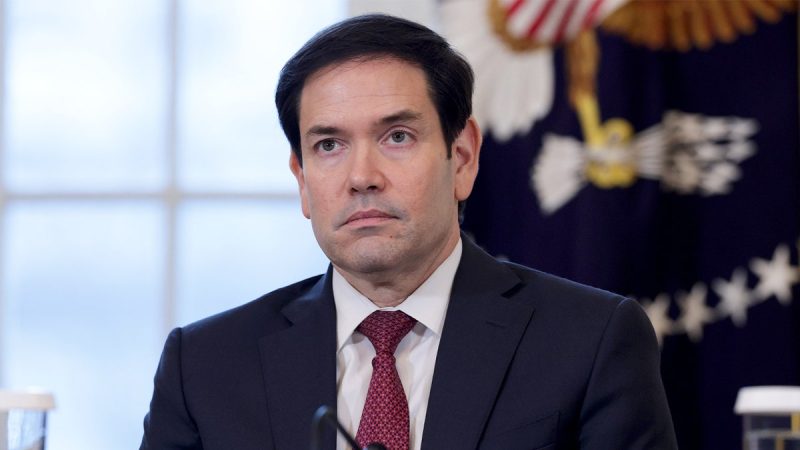
Secretary of State Marco Rubio will publicly testify on the Trump administration’s policy in Venezuela Wednesday morning after vowing to lawmakers that no more military action was expected in the region.
Rubio’s return to the Hill, an increasingly frequent occurrence in recent months, comes after he, President Donald Trump, administration officials and Senate Republican leadership successfully killed a bipartisan push to rein in the president’s war authorities in Venezuela.
His scheduled appearance before the Senate Foreign Relations Committee Wednesday at 10 a.m. comes just weeks after he helped to convince two lawmakers, Sens. Todd Young, R-Ind., and Josh Hawley, R-Mo., to flip their votes and back the administration.
Both were concerned about boots on the ground in Venezuela and Congress’ constitutional authority to weigh in on the matter.
They were convinced by Rubio and the administration that no further military action would take place, and that if it were, President Donald Trump would come to Congress first.
Young said at the time that the effort, spurred by Sen. Tim Kaine, D-Va., was ultimately just a messaging exercise that never would have survived in the House, nor evaded a veto from Trump.
‘I had to accept that this was all a communications exercise,’ Young said. ‘I think we [used] this moment to shine a bright light on Congress’ shortcomings as it relates to war powers in recent history.’
Rubio also wrote to Senate Foreign Relations Chair James Risch, R-Idaho, to spell out that the administration would clue in Congress should any future military action take place in the region.
‘Should there be any new military operations that introduce U.S. Armed Forces into hostilities, they will be undertaken consistent with the Constitution of the United States, and we will transmit written notifications consistent with section 4(a) of the War Powers Resolution (Public Law 93-148),’ he said.
However, Rubio’s appearance before the panel comes on the heels of unrest stateside following another fatal shooting in Minnesota, where Alex Pretti was killed in the midst of a Department of Homeland Security-led immigration operation in Minneapolis.
While he won’t have to answer for that situation, it has drastically shifted the Senate’s attention over the last several days.
It also follows Kaine’s vow to file several more war powers resolutions against Trump, specifically against action in Greenland, Iran and elsewhere.
Kaine believed that he could take advantage of cracks that formed in Republicans’ unified front earlier this month, when five joined all Senate Democrats to advance his resolution to require any future military action in Venezuela would need Congress’ approval.
‘The way cracks grow is through pressure and the pressure campaign that I sort of decided to launch by use of these privileged motions,’ Kaine said after his initial push failed.
‘I’m going to file every one I can to challenge emergencies, to challenge unlawful wars, to seek human rights reports, arms transfers if they’re wrong,’ he continued.